Translate Blog

Showing posts with label A French Connection. Show all posts

Tuesday, March 31, 2015

France, Part 15 - Chananceaux Farm, Part 2


For the first time in a while I find myself writing from memory and not from the journal I kept while we visited in France.  Looking back though at the pictures of Chenanceaux I thought it deserved a second part as the gardens and farm of the chateau are an entity to themselves.


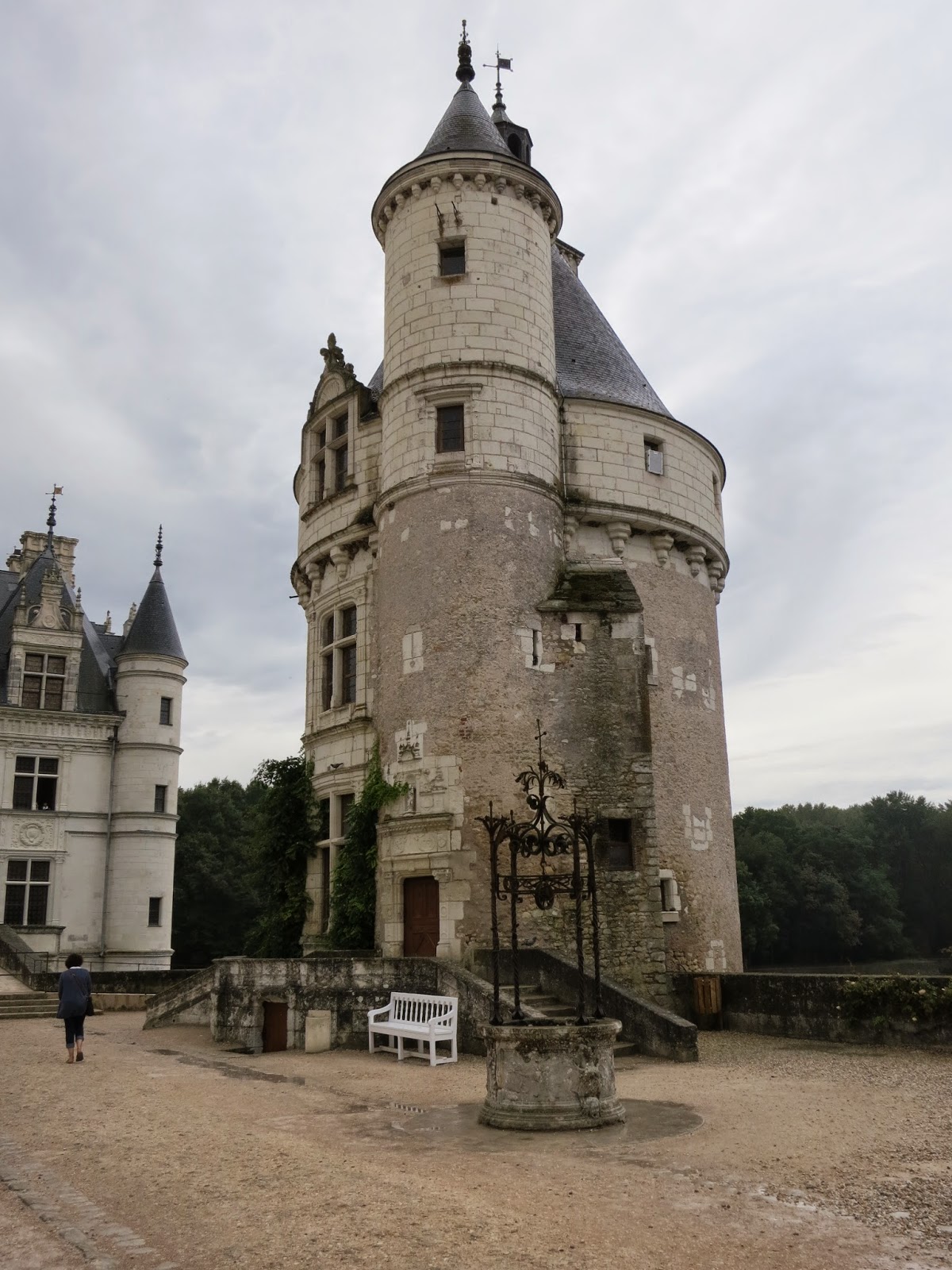
While there are formal gardens built by the Medici owners and those who came before and after, the farm of Chenanceaux acts almost like a small village to itself.   If Chenanceaux is Sleeping Beauty castle, then the farm and gardens are the home of Cinderella and they have a unique charm all their own.  My first impression was from a distance as we walked to the castle, and then my focus was on the castle.


I caught the hint of flowers, of a small field with donkeys, and a few buildings.   Like the garden at Clos Luce, this had once been a working part of the great house, providing food and housing staff who likely worked the lands around back in the days before even the "Le Ancient Regime"  of Louis XIV and his descendants.


Chenanceaux rises as a white faced lady over the trees surrounding the farm, with tall roofs like black miters perched on shapely heads.  The windows face out to the rivers, the forests, and the farm itself. There is a remarkable abundance of flowers in neat beds lined all up around a mill and other farm houses.


There are also vegetables, and no shortage of small and large things to pause to look upon.


Many visitors to the castle might easily miss these things, but for me I made certain we doubled back around once we were outside, and it proved well worth it.


One of the reasons I suppose I call this a Cinderella area as opposed to alluding to Sleeping Beauty is the garden itself.  I associate the pumpkins and little animals, and its not hard to imagine a woman riding a transformed squash back to Chenanceaux to a ball.  Looking back on it now, it seems storybook but in reality the people who worked farms such as this lead a hard life.   Paris might have been the heart of the revolution which toppled so many great houses, but it was in places like this that the long arms of that shadow crept to end the fairy tale nature of many noble lives.


Finally I should speak to the forest itself.  It is vast, so vast I have no accurate way to describe it.  Standing back at one of the formal gardens and looking back at the chateau, I chanced a look into the woods.  Long columns of trees surrounded a path, which while lit with shafts of light from the boughs descended into darkness.   This was certainly a Grimms sort of feel, especially on the far bank where the German border used to be back after World War II.


Chenanceaux was to be our penultimate location in the Loire Valley, which in itself is very much a fairy tale landscape of castles, quaint towns and beautiful countryside.   We had a long way to go to find our place to stay, and we were not going to be disappointed when we arrived.

Wednesday, March 18, 2015

France - Part 15, Loire Valley and Chateau chenanceau, Part I


I was sorry to leave Ambois, but our journey to other places in France still waited on the open road.  So we woke up early to a simple breakfast and hit the pavement in our car with a destination of Saumer.  On the way we would stop by the Chateau chenanceau, supposedly one of the inspirations for Sleeping Beauty castle at Disneyland.  Looking at it from outside and in, it’s not hard to see the similarity in some respects.  The castle is a beautiful one, with white walls and dark towers, but it is more long than it is tall, spanning the length of a river that runs underneath it. 


Behind and on either side, the chateau is flanked by thick forests and trees, with beautiful gardens and a farm on the grounds.  The gardens are spectacular, with vegetables and flowers arranged in neat plots and so carefully tended by loving farmers.  We spent quite a bit of time wandering this section of the grounds alone, looking at the different colors and shapes that seemed arranged like on an impressionist painting.


The inside of the castle was lovely but too crowded.  Tour groups pack fifteen to twenty-five or more people into rooms that probably can hold a maximum of four or five.  Nevertheless, it was a very different experience than Chambourd.  That castle had the influence of men, but this castle was built and influenced by the tastes of three very different women.   As such, it is more refined, warm and welcoming.  There are not huge empty rooms or the smell of fire smoke, and there’s not a hunting trophy to be seen on any of the walls. 


The gardens and the initial chateau itself are the legacies of Diane de Poitiers, mistress to Frances I.  Her rooms have a distinctly warm but medieval feel.   Then there were lovely long hallways decorated with artwork from Marie Medici, her rooms are distinctly Italian.  Finally is a single room, all in black, with tapestries stitched with skulls and crossbones.  This is the domain of Louise de Lorraine whose husband, King Henry III, was assassinated, sending her into a life of mourning. 


I’ll talk about this last room first since it is the most strange.  I spent all of two seconds in here, because there was such a crowd, but there was a very creepy vibe in there.  I honestly felt very uncomfortable.    If this was Sleepy Beauty castle, then this room would have been the spindle wheel room.


You can see how many people were packed into this room
Moving on, I was quite taken by how charming the servants and public spaces were.  The whole house is warm and light and there is a distinct feminine charm.  Little touches like bells on the wall reminded me of Cinderella and I wondered if Disney got the idea for bells in the animated movie from this little detail.  There were huge old tapestries on the walls, but even these seemed to add a charm rather than a stoic, dark feel like they had at the previous castles. 


Small "servant's kitchen

I don't know why but this reminded me of Cinderella.


Bread Oven

 Some of the kitchens seem almost modern by comparison, and were very impressive, most of the rooms were large enough to feel grand and spacious while the decorations were warm and homey.   I had the hardest time getting pictures because of the groups unfortunately


Another kitchen


These were lovely tapestries

This is the Medici Bedroom I beleive

There were drawings all over the house of the building itself


The first floor of the long hallway

Next I should talk about the "Long Hallways."  The long halls have the most interesting history, while the upper floor is an art gallery from the time of Marie de Medici, the lower floor spans the length of the river to the other shore.   It is here on the wall that one will find a plaque and a flower arrangement of red, white and blue.   After World War I, certain lands were ceded to Germany by France and the river became a boundary mark.  As such, this section of wall, and the flower arrangement marks the end of that boundary and the beginning of French territory even into World War II. 

The "Old Border"

The story goes that German patrols went up and down this river in that time, but that the French Resistance had a pathway to and from Germany through the long hall provided by the museum curator.   They’d enter through one door from Germany, and exit through the other into France.   It was kind of cool to think about as I gazed down that long corridor. 

Second Floor of the Long hallway
Something about the castle and paintings such as this one just reinforces its status as an inspiration for Sleeping Beauty Castle
We left Chenanceau with a really good feeling about the place.  On the whole, it set the benchmark for our desire to see any castle in France again, because all others paled by comparison according to the descriptions.  My grandfather used to have a saying, “ABC – another bloody castle” when he was touring Europe.  After a while you get tired of seeing castles and crowds and that was us for the remainder of the trip from that point.   There was more to the castle of course, a vast, beautiful farm and garden, but that is for next time!


Tuesday, March 3, 2015

France - Part 14, Ambois and DaVinci's Garden


The gardens of Chateau Clos Luce are the size of a small park, with interwoven paths marked by full size replicas of the master's great inventions.   When we came to the museum, we had no idea how large it really was in entering the house.  One glance at the map and we were intrigued enough to see, and it was well worth it.

Full size Tank, minus the guns, but it DID spin.

Full size machine gun, complete with working smoke from the guns.


Mom trying the Archimedes screw, it carries water up a spiral.
There must be dozens of full scale working models of Da Vinci’s inventions along the paths here.  I took a spin in the Tank (its not a real tank of course) and Mom tried the Archimedes screw.  There was a nice vegetable garden, and several other exhibits including a side museum that housed Da Vinci’s flying machine.   It looks exactly like a plane for one person.   There were also scale models of Automaton, moving machine-like toys about the size of dogs.  

Lion Automaton

Flying machine

The lion we saw inside was used at parties, and supposedly along with being painter, sculptor, inventor, genius, Da Vinci liked to plan parties.  He would arrange the whole affair and these “little” things would march around and open up reveal fantastic gifts like jewels, flowers and other things inside.   The rest of the museum had sketches and designs of his various other works.  We spent a long time here, admiring it all before meandering back through the garden once more. 

Sketches of dogs?


On the whole the Close Luce was very much a hands on museum once you got outside and it was well worth the whole trip just to see it.  We spent quite a few hours there before walking up along the old streets towards the castle grounds.   The town of Ambois was very much like Chartreaux, with narrow streets and little houses hugging the hills.  Some places looked like they’d been dug out of the hillside centuries before and were still lived in.

Lovely peacocks
Little ducks and hens

Gorgeous flowers


I was tired, and really not feeling well, so we stopped in the shadow of the castle to decide on lunch.   It was here that we found and sampled the only recommendation from among the many provided by our guides.  It was just pure luck that we stumbled on it honestly.  If we’d gone a different direction away from the castle and back down to the hotel like we planned, we would have missed the place entirely.

The Castle and upper town

L'epicure Restaurant
The restaurant is called L’Epicure.  It’s a tiny place just along the street, and as we sat down and rested there I felt right at home.  There was a nice breeze a little shade, fresh water and lemonade.   I amused myself with petting a dog at the next table and glanced over the menu.   I can say right now, I am no fan of eggs.  My parents will tell you I loathe and despise them scrambled, hard boiled, sunnyside, fried, anything.  Looking all the other choices, I didn’t want to go through a full 2 hour lunch service and so I ordered an omelette and hoped to God I wouldn’t regret it.  

Friendly dogs included.

Well I didn’t.   In fact, this was the best omelet I had in my life; warm and moist, deliciously packed with cheese.  I devoured that thing, and I would devour it thirty times over … it was that good. I make this statement whole heatedly as a person who loathes and despises eggs, that I could eat eggs 3 times a day at that restaurant for the rest of my life.   If the eggs weren’t enough, there was an incredible dessert. 


Our meal at L’epicure was miles beyond the comparison to the dreadful meal at the hotel.  Where we’d paid 80 euros for a terrible meal, we paid less than half for a wonderful one at L'epicure.  This meal in itself was a highlight of the trip, and an exclamation point to a wonderful experience back at Clos Luce.  This meal in itself is worth a trip.


Streets of Rue National
Colorful displays at a grocer


With lunch finished we walked back through the Rue national, a pedestrian street with lovely shops and stalls.  There were all sorts of delicious and beautiful things here, almost too many to describe.   Vines grew up the side of a great old clock tower in the center of it, and people sat and talked happily from the cafes.  It was an ideal place, one I would have liked to spend much more time exploring.   We finished the day with dinner at a little bakery there before returning to the hotel to rest. 

A lovely rainbow to end the day.

As I sat in the room, I reflected on everything that happened while listening to the bells ringing somewhere nearby.  Ambois feels special when in comparison to Chartres or many of the other towns we visited.  The buildings, large and small, short and tall seem to lean upon each other like lazy neighbors.  Some have gardens, and others simple gravel.  It feels like a town where generations could grow up beside other generations and still know someone who knew DaVinci way back when.  


All of this guarded by the astounding legacy of Da Vinci and Francis I.